Showing posts with label Trivia. Show all posts

Wednesday, December 12, 2012

The Most Famous Deer of All

Rudolph, letting you know it is cool to be different
'Tis the holiday season, and whether or not you celebrate Christmas specifically, no doubt you have been bombarded with Christmas music since Thanksgiving. I dabble in said holiday fare, but don't indulge so much as to ban any non-seasonal tunes, like some folks I know. And by know I mean am related to. Anyway, I was listening to the radio the other day and of course Rudolph came on, because it had been 45 minutes, and I was struck, once again, by how mean the other reindeer were. Total bitches! Even his own parents try to hide who he really is! And when Rudy finally rises to red-beaked glory and saves the day, there is never really any just recompense from those haters.

Typical. My (indirect) point is, I've been thinking about reindeer, and not just the bitchy kind. I figure you good people think about reindeer too, sometimes. But how much do you know about them? In the spirit of giving, I give you . . .

Ten! Facts! About Reindeer!:

1. Semantics
Reindeer = Caribou = Rangifer tarandus

2. Nice Rack
Caribou have the second biggest (but definitely most crazy) antlers of any Cervid, behind the moose. They are the only Cervid species that practices equal growth rights: both males and females grow antlers. Interestingly enough, older males drop their antlers in the early winter, young males lose theirs in early spring, and  females keep theirs until the summer. So all of Santa's reindeer must be ladies then, no? Not at all surprisingly, their ground up antler powder is a big hit in the aphrodisiac-centered, horned up Asian market.

3. Glow-in-the-Dark Pee?
Okay, not exactly, but it is thought that caribou are the only mammalian species that can see ultraviolet light. This megavision helps the animals to pick out useful things that might otherwise blend in with the monochrome tundra landscape. Things like urine.

4. Big Nose, Fancy Toes
Their huge, smoochable schnozes are equipped with cavernous nostrils that help to warm inhaled air before it enters their lungs. In the winter their normally spongy foot pads harden and shrivel up, exposing the sharp edges of their hooves. This helps with traction on ice, and provides a handy shovel for digging out snow in hopes of grazing. I also tend to shrivel up in the winter, although I have yet to notice a positive correlation on my traction or eating habits.

5. Walkathon
Some North American herds migrate the furthest distances of any terrestrial mammal. They can travel over 3000 miles in a season. Total badasses.

Delicious!
6. Good Eatin'
Reindeer eat a lot of lichen. Reindeer lichen, specifically. They'll also tear into some mushrooms, and rumor has it, the occasional lemming. But I don't know about that. Northerly humans love to nom on reindeer, and the animal (both wild and semi-domesticated) has been a seminal human food source for centuries. Most recently in canned meatball form. I am sure Sarah Palin loves them.

7. Where in the World?
Caribou range pretty much all over the Holarctic zone, across tundra and boreal forest habitats. Once abundant, their numbers are in decline due to habitat degradation and the biggest bummer-trump of all, climate change. Read more about hard times in reindeer land in Gretel Erhlich's fine National Geographic piece on Russia's reindeer herders.

8. I Vant Your Blood
Apparently colonial Frenchies used to mix the blood of caribou with a little hard booze and drink it down to fight off the cold. And perhaps anemia. The modern incarnation of this Caribooze substitutes red wine for blood and adds a bit of sugar or maple syrup to the existing whiskey. Naturally the Quebecois love this sort of abomination.

9. The Elite Eight
Fact: The names "Donner" and "Blitzen" are derived from Germanic words meaning Thunder and Lightening, which makes a strange kind of sense, but leaves Vixen and Cupid as the most questionably-named dudes on the crew, and possibly in reindeer history.

10. Born Free
There are lots of free-ranging, wild herds of reindeer in the world. So too are there semi-domesticated herds. Arctic and Semi-Arctic peoples have been shuffling these fuzzies around for centuries, using their hides, meat, antlers, and even milk, though such animals weren't really considered to be domesticated, and they weren't bred in captivity. Its more like they were partially tamed. Today some nomadic herders track their herds using satellite telemetry. Maybe that is how Santa keeps tabs on his during the off-season...


Tuesday, July 17, 2012

Bad News Bears

As you may or may not know, I am spending another season collecting bear hair in Northwestern Montana. Every so often, whilst we are burgling the fur clumps left on our rub trees, a park visitor pops around the corner and asks if we can tell what kind of bear left that hair? The honest answer is no, not really. Black bears can be any number of colors, and at the end of the day, it is hard to tell for certain their fur from any shade of grizzly, unless it is that deep blue-black hue. That said, we can (more or less) safely say what kind of bear hair we are not collecting. In keeping with a series, here is:

A (partial) Guide to Recognizing Your Bears


File:Darica Brown Bear 00963.jpg 


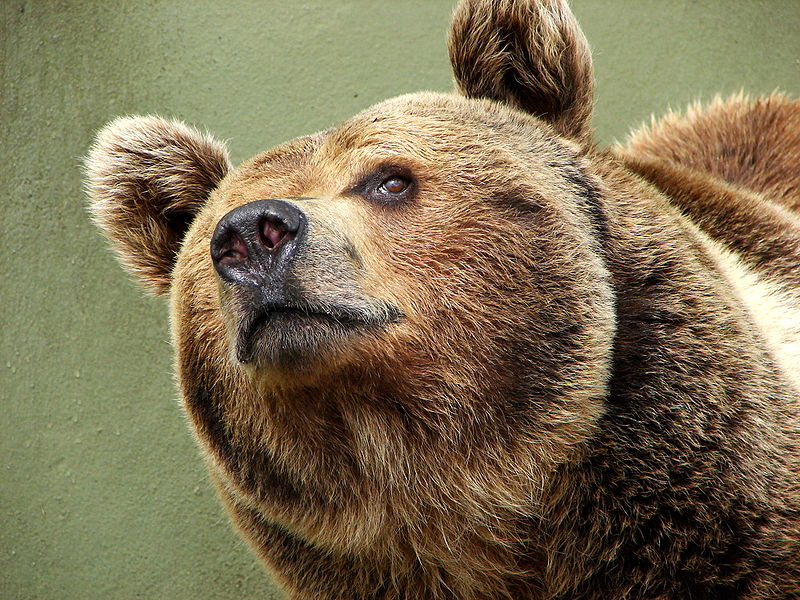
Brown Bear:
Range: Northern North America, Europe, Asia, Wall Street.
Diet: Lots of vegetation, berries, fruit, carcasses, fish, grubs. Mammals great and small, if it feels like a chase. Grizz eats whatever the hell it wants.


American 
Black Bear:  
Range: Behind you!
Diet: Mostly vegetation, berries, roots, grubs, fruit, honey. Also, carrion, trash, dog food, baking supplies, anything they can get their paws clawed on.


 1920x1440 Swimming polar bear                            
  Polar Bear:
Range: The Arctic.
Diet: Ringed, harbor, bearded, harp, and hooded seals, other blubbery marine mammals, including the occasional beluga whale. I said whale! 
Random fact: The biggest in the family, polar bears are so well insulated their body heat does not register on an infrared devise. This makes them excellent spies.


Asiatic Black Bear (Ursus thibetanius)Asiatic Black Bear:
Range: Mountain and tropical forests of Southern Asia, Northeast India, etc.
Diet: See American Black Bear.
Random Fact: These guys are largely nocturnal, and are called Moon Bears because of that crescent-shaped chest bling they sport. Dandies.

Sun bear1 Sun Bear As A Pet
Get it together, Sun!. You look like a Shar Pei with heat stroke.


Sun Bear:
Range: Rain forests in various Southeast Asian countries.
Diet: Typical jungle fare: honey, insects, veg, fruit, rodents.
Random Fact: Rarest. Smallest. Most ornery. Sun bears love slurping up honey and termites with their  crazy long, skinny, semi-creepy tongue.


  ~ ~ ~Intermission~ ~ ~


Sloth Bear
Hello, is it me you're looking for?

  Sloth Bear:
  Range: Forest and grasslands of India,
  Nepal, Bangladesh, etc.
  Diet: Mostly termites and ants (check out
  that schnoz), but anything will do.
  Random Fact: The Sloth Bear's Lionel
  Ritchie-esque   shaggy faux-mullet ear/neck
  fur help keep little insects away. And that
  ain't the half of it. They have long tongues,
  can close their nostrils and curl their lips
  over their noses, and lose their front top
  canines,  all to better suck up insects.
  Apparently their aggressive hoovering
  can be heard 300 meters away.


WWF Bolivia
                                      Not amused


  Spectacled Bear:
  Range: Northern and Western South
   America.
  Diet: Fallen fruits, palm nuts, orchid
  roots, honey, sugarcane, cactus.
  Random Fact: Closest living relatives
  of the epic Short-Faced Bear of
  Pleistocene fame. Named for face
  markings vaguely reminiscent of
  corrective eye wear.


Ready for my close-up


  Panda Bear:  
   Range: Southeast China. 
   Diet: Bamboooooo! Only bamboo.
   International poster bear for adorable.


care bears Care Bear:   
Range: Kingdom of Caring, Care-A-Lot, the Forest of Feelings, my first-grade birthday cake.                               Diet: Sugared cloud cones, the hopes and dreams of young children, mainlined love.

                                                     Bear Grass:                Range:Western North America                   Diet: Water, sunlight.

http://www.hottiesoftheday.com/males/celebrities/bear-grylls/beargrylls9.jpg


Bear Grylls:
Range: Atop Mount Everest, north-Atlantic icebergs, jungle ditches, free falling through mid-air, under piles of leaves, up in trees, on book stands everywhere.  
Diet: Raw organs, insects great and small, urine, deer shit, real vowels, and basically whatever it takes to SURVIVE!


no preview 


Gummi Bear:  
Range: Happy bellies and cavity-ridden mouths worldwide.  
Diet: You're not on one if you're eating these bears.


The Gay Man's Bear: 
Range: San Fransisco, Miami, D.C., New York,  Seattle, worldwide. 
Diet: Listen, what a bear eats in the privacy of his own home is no body's business but his own. 


Walter Payton Chicago Bears NFL Football Sweetness Most Prolific Runningback Running Back MVP Player year NFL Football Player 


Chicago Bear:  
Range: Chicago and fields away. 
Diet: Coors Old Style, chicken wings, deepdish, haters. Just check The Fridge. Ha! Then please, watch this! 

Monday, December 19, 2011

Oh, Royal Tannenbaum

Today, on this cold and blustery upper-Michigan Monday, my intrepid mama and I crunched out into the far reaches of the back woods and cut down a wee Christmas tree. Well, the little guy is more of a sapling than a tree-tree, more of a Charlie Brown than a General Sherman, but still. This was my first tree-cutting excursion in many years, and, being the soft-hearted ninny that I am, I was predictably conflicted. I mean, no question, no question, real trees are far more magical, special, and deliciously-scented than their Made in China alternatives... but it does feel like a huge luxury/waste to cut one down just to tart it up with glitter and bling for a few weeks before literally kicking it to the curb. And yet our little, ultra-local tree was one of many in a thick patch of forest regrowth that probably would have been out-competed eventually. Anyway... We gave thanks to its brief but wild life before crouching down in the cold, and working a small saw clasped in a mittened-hand.

As we walked back to the house carrying the tree and a bouquet of red willows, I started thinking about the tannenbaum tradition. And so, after a little interwebbing, I bring you some random yule-tree factoids:

- The first known Christmas tree was decorated in 15th-century Livonia (now Latvia and Estonia) by the dubiously-named Brotherhood of Blackheads, who sound like your typical bachelor-merchant group of sketchy dudes executing bizarre night-rituals while, let's face it, likely wearing funny hats. But to be fair, the tree-honoring tradition was probably co-opted by the Christians (like so many holidays) from some tree-hugging, dirt-worshiping pagans doing their freaky Solstice dance, while yes, wearing funny headgear.

- The German word for Christmas tree is not in fact, Tannenbaum. Apparently that describes just your average fir tree doing its thang. No, the Germans call their Christmas trees "Weihnachtsbaums," which to me sounds a bit like a sticky nocturnal digestive situation.

- Artificial trees first arrived on the scene in the 19th century. They were made of the most obvious evergreen-needle substitute around: goose feathers dyed green.

Don't get me started on the jazzy firewood brought to Britain by farmhands looking for free beer from sexy farm wives, aka the Yule Log.

Tuesday, May 31, 2011

What Fresh Hell Is This?

A Brief Survey of Choice Traditional Irish Ballads:
Or how to be a truly sad and lovesick bastard

(1) Danny Boy
(Classic Irish heartstring-puller, in which our dear Danny Boy is heading off to war, pretty much guaranteed never to see the singer, or a good day, again.)

"And if you come, when all the flowers are dying,
And I am dead, as dead I well may be,
You'll come and find the place where I am lying,
And kneel and say an "Ave" there for me."


(2) Fields of Athenry
(That same old story in which a young lad is arrested for stealing the lord's corn, and thus set adrift on a prison ship bound for Australia, leaving his true love a single mother...)

"Against the Famine and the Crown
I rebelled they ran me down
Now you must raise our child with dignity."

(3) I'll Take You Home Again, Kathleen

(In which a beloved wife dies a slow and painful death, and her devoted husband escorts her body back to her native Ireland. Incidentally, my grandpa Van used to sing this song to me when I was but a wee lass. Because we liked to keep it real and not sugar coat it.)

"The roses all have left your cheek, I've watched them fade away and die..."

(4) An Emigrant's Daughter
(A haunting sea shanty in which a daughter is put on a boat to America. But she gets a fever. She starts hallucinating. And, because this is an Irish Ballad, she dies. The they throw her body into its watery grave.)

"Oh please ne'er forget me though waves now lie o'er me
I was once young and pretty and my spirit ran free,
But destiny tore me from country and loved ones,
And from the new land I was never to see."


(5) Carrickfergus
(In which a man starts hitting the bottle after being cuckolded by a bawdy and humorous ditty.)

"But I'll sing no more now till I get a drink,
For I'm drunk today and I'm seldom sober..."

(6) My Dark Rosaleen
(Here a man gets his serious pine on while missing his boo, Rosie.)

"Woe and pain, pain and woe,
Are my lot night and noon,
To see your bright face clouded so,
Like to the mournful moon."

(7) I'm Stretched on Your Grave
(I think this one pretty much speaks for itself...mel-o-drama!)

"I am stretched on your grave and I'll lie there forever..."

(8) The Wind That Shakes the Barley
(In which a doomed young rebel loses his love and marches into the 1798 Irish Rebellion, pockets stuffed with oats to munch along the way. Of course, it all ends badly. *Interesting side note: Random patches of barley popped up all over the countryside post-rebellion, indicating both the mass unmarked graves of Irish soldiers (barley in pocket), and symbolizing that stubborn Irish tenacity and a big fuck off to British rule. The Wind that Shakes the Barley is also a gorgeously sad film starting the extremely easy-on-the-eyes Cillian Murphy. In layer upon layer of fine Irish tweed.)

"While sad I kissed away her tears, my fond arms round her flinging
The foeman's shot burst on our ears from out the wildwood ringing
A bullet pierced my true love's side in life's young spring so early
And on my breast in blood she died while soft winds shook the barley."


(9) Four Green Fields
(This song is in it to win it. It pretty much delivers all the goods... plundering, pillaging, loss, starvation, dead family, blood, guts, screaming children, British invasion...)

"There was war and death, plundering and pillage
My children starved, by mountain, valley and sea
And their wailing cries, they shook the very heavens
My four green fields ran red with their blood, said she."


But, for all their suffering, and proclivity for reliving that suffering nightly through song, the Irish also have a tremendously big-hearted, admirable, and irreverent sense of humor.... and so I leave you with this gem..

(10) Lily the Pink
(In which the dubiously named witchy woman Lily the Pink prescribes her medicinal compounds to cure whatever ails the locals, for which she is immortalized in a drinking song.)

Quotes won't do it justice, so you'll just have to listen and watch this amazing cover here.

Sunday, May 29, 2011

Forty Shades of Green

The Dingle Peninsula
Yes. There is a real place called Dingle. Berries do not grow there, but peat does. And rocks. Rocks thrive there. And a resident dolphin. In 1984 a lone little dolphin swam into the harbor and never left. Curious and friendly, he has entertained tourists and locals ever since, although "to show his freedom, he never accepts fish thrown by divers or trawlers." And how did they repay this congeniality and independence? By christening him with the magnanimous name of Fungi. I don't know what they were thinking. Apparently the name is somehow related to the fisherman who first took a shine to the little tursiops. Apparently his fellow fisherman mates thought it was decidedly uncool to like girly dolphins and stuff, AND, dude couldn't grow a legit beard, so they taunted him with the nickname Fungus, which they then creatively transferred onto this poor, unsuspecting dolphin.


Going back to Ireland involves at least six to seven emotional breakdowns for me per day. --Anjelica Houston
Anyway, we did not see Fungi the Dolphin, although I couldn't resist riding his bronze likeness in the harbor square. We did see forty shades of green, herds of woolly sheep, one billion rock walls, the ruins of famine huts (just the laughfest they sound like) miles of insanely narrow, curvy cliffy roads, old cemeteries, and the sea, the sea, the sea. The country is undeniably beautiful, but it is veiled in a deep sorrow, too. It is so easy to see how cold, damp, and difficult poor farming life would have been like in these hills. The very definiti0n of hardscrabble. The embodiment of suck-it-up, stiff-upper-lip, and keep-your-head-down. The Great Potato Famine (courtesy of another, distinctinly less fun fungus) occured between 1845 and 1852 took out a million Irish, causing the country to lose nearly 25 percent of their population to death and emigration. Ireland's collective history is thick with tragedy. That is probably why they make such fine whiskey and sing the sweetest, saddest ballads in brogue around. Aye, aye, aye, the Blarney Stone really will bring a tear to your eye.


And the Larks They Sang Melodious
But if you want to hear more about it, quit reading this tripe and listen to the Man in Black sing about it, (even if he was more Scottish than Irish). Famine and smokey peat fires aside, in the end, you know it usually always comes down to missing a girl.


And, oh, yes.
Tonight I pretty much got what I wanted out of Ireland... three hours of an old man pick-up band singing in a pub called Durdy Nelly's (plastered with police badges from the states, incidentally), calling upon Guiness-swigging patrons to sing traditional songs, chorus roaring, hands on shoulders, tweed caps and wool, bohdran and squeezebox. I stood on a bench, clogging my heel against the dark wood, grinning like a fool, knowing I was exactly where I was supposed to be.

Tuesday, May 24, 2011

My Name is Yon Yonson

I come from Wisconsin.

Which, incidentally, is where I have spent the last ten days. In Madison, my hometown. I can't seem to come up with a specific or cohesive theme to discuss here, (aside from the now infamous Series of Unfortunate Events that have recently transpired at the capitol) so I'll just present some random observations in brief summary...
But first, a primer on the awesomeness that is Wiscony:

Fact #1: Take that Minnesota!
Wisconsin has over 14,000 lakes and 7,446 streams and rivers. I think you'll find if you do the math that is considerably more than 10,000.

Fact #2: One word is enough.
Wisconsin' motto is simply "Forward". No big deal.

Fact #3: Helping men maintain their virility.
Wausau is the Ginseng Capital of the World.

Fact #4: We heart cows and healthy bones.
Wisco has more dairy cows than any other state (1,500,000), produces more milk than any other state -- and 15% of the entire country's milk.

Fact #5: Badger don't care.
Our state animal and UW's mascot is the badger, and undeniably badass animal. Seriously, though short and rather portly, a badger will take on a bear if it needs to. Texas's motto may be Don't Mess, but their state animal is a Longhorn. A badger could take a cow down at the ankles, eat it up down to the bone, then turn its ribcage into a veranda.

Anyway, just saying.
Its been a lovely trip of visiting old friends and seeing nearly everyone in both of my immediate families. A baby sister graduated from UW (she was, I believe, something like the 14th member of my family to do so... we're legacy!) A grandfather was honored with a memorial bench overlooking the lake. A brother got married. A nephew was schooled in the power of the slow burn rainy-night-sax-solo in Careless Whisper. Flowers were arranged. Sundries were wrapped in grape leaves and drizzled in olive oil. Cakes were decorated. Lilacs bloomed. Hair frizzed. Cheese curds were eaten. Arrangements were made. All was good.

Tonight I head out for a week in western Ireland! Updates to follow...

Thursday, February 3, 2011

Release the Kraken

I saw a Colossal Squid (Mesonychoteuthis hamiltoni) today. 
She was dead and pickled, and about as pretty as you would expect a dead, mushy, and beige cephalopod to be, but still, she was really something.


Wellington's Te Papa Museum holds the only colossal squid specimen in all the world. Some New Zealand fishermen pulled her up from the deep off the coast of Antarctica in 2007. They were...pretty surprised. She was still alive, all bright-red caped and churning, feeding on the toothfish they had hooked, but these krakens can't survive in surface waters, their blood can't carry oxygen well up top, and they suffocate. She was fading. They hauled her in, put her on ice, and donated her to the museum. Eventually biologists found a creative way to thaw her (deciding that slow saltwater baths were better than big microwaves)...whence they had a few precious hours to do some poking and prodding before pumping her up with preservatives and transferring all nearly-1100 pounds of her into a watery, space-age, transparent coffin. Which is where I bumped into her...


     Co-los-sal: 1. extremely large. 2. of an exceptional or astonishing degree.

I figure that you'll want some Colossal Squid Trivia now, because, well, who wouldn't?


Notorious B.I.G
They are big. Really big. Biggest invertebrate in the world. This is based on the handful of immature specimens that have ever seen the light of day. The Te Papa squid is little, only about 14 feet after shrinkage. Current estimates of the big dogs puts them at 35-45 feet long.

The Squid and the Whale
They are badass predators, decked out with crazy rotating-hooked tentacles that could make a medieval weapons expert weep. And mess you up. Bad. They are the only animal in the world that has a shot at fighting a sperm whale (the world's largest predator, you know.) Even though the whales usually win (their stomachs jangle with many a hard squid beak), a big squid can leave them all cut and scarred.

Eyes of the World
They have the biggest eyes in the world. A foot or more in diameter. Looking at you. They also have eight arms. Two tentacles. One scary, black, parrot beak. And a lot of style.


Friday, January 14, 2011

O, Possum

Alright, so I've been getting questions about the possums. I feel the need to clarify that we are not talking about that rat-faced, pink-tailed, dead-acting Opossum of North America. (Sorry too disappoint those among you who were reveling in the idea of kiwis walking around in barbaric ragged, gray fur capes fringed with bare tails swinging...)

Turns out these little brushtail possums  are reasonably cute.

Unfortunately they are also hideously invasive, procreationaly gifted, night-stalking, tree-killing, diabolical bird-murderers. These crimes and others have landed them the dubious title of Public Enemy No. 1, although stoats are a close second. Both species are destroying the native flora and fauna, taking an especially heavy toll on the beloved flightless birds, like kiwis and keas, by eating their eggs and chicks.

New Zealanders are quick to bitch about these fuzzy pests (first introduced by settlers to start up a fur trade, go figure, they are often called "squash-ums"). They trap and kill them with chilling enthusiasm. Traps are everywhere, poison is dropped from the skies into certain areas...water is poisoned... The DOC says this warpath has reduced the estimated population from over 70 million to around 30 million over the last two decades. Well that is promising... Only 30 million to go, boys! Maybe the government should think about introducing some predatory cane toads next. Teach them to hunt possum. With small spears. Brilliant.

But in typical kiwi do-it-yourself fashion, there is some lemonade to be had with all of these lemons. They call it merinomink, or possumdown, or Eco-fur. While the names are ridiculous, the notion is a good one and all of the fur comes from wild-caught pest animals. No matter how unnerving it is to see a truck drive by with the side painted "cashmere extermination," I have to say, I am glad the animals are used for something. I don't know what PETA would say.

Maybe the idea will catch in the states and your next pair of fancy Christmas socks will be made of rat-fluff or pigeon-suede...

Friday, November 26, 2010

Barbara Hamby

A much-needed random poem of the day. One of my favorites...

Thus Spake the Mockingbird

The mockingbird says, Hallelujah, coreopsis, I make the day
      bright, I wake the night-blooming jasmine. I am
the duodecimo of desperate love, the hocus-pocus passion
      flower of delirious retribution. You never saw such a bird,
such a triage of blood and feathers, tongue and bone. O the world
      is a sad address, bitterness melting the tongues of babies,
breasts full of accidental milk, but I can teach the flowers to grow,
      take their tight buds, unfurl them like flags in the morning heat,
fat banners of scent, flat platters of riot on the emerald scene.
      I am the green god of pine trees, conducting the music
of rustling needle through a harp of wind. I am the heart of men,
      the wild bird that drives their sex, forges their engines,
jimmies their shattered locks in the dark flare where midnight slinks.
      I am the careless minx in the skirts of women, the bright moon
caressing their hair, the sharp words pouring from their beautiful mouths
      in board rooms, on bar stools, in big city laundrettes. I am
Lester Young's sidewinding sax, sending that Pony Express
      message out west in the Marconi tube hidden in every torso
tied tight in the corset of do and don't, high and low, yes and no. I am
      the radio, first god of the twentieth century, broadcasting
the news, the blues, the death counts, the mothers wailing
      when everyone's gone home. I am sweeping
through the Eustachian tube of the great plains, transmitting
      through every ear of corn, shimmying down the spine
of every Bible-thumping banker and bureaucrat, relaying the anointed
      word of the shimmering world. Every dirty foot that walks
the broken streets moves on my wings. I speak from the golden
      screens. Hear the roar of my discord murdering the trees,
screaming its furious rag, the fuselage of my revival-tent brag. Open
      your windows, slip on your castanets. I am the flamenco
in the heel of desire. I am the dancer. I am the choir. Hear my wild
      throat crowd the exploding sky. O I can make a noise.

Monday, November 22, 2010

Alas, Poor Yorick....

Skulls! Bones! Y'arrghh!

The other day I found a little mouse skull resting at the base of an oak tree. As I cradled the lightweight, delicate curve in my open palm--the white bone nearly transparent, thin enough for light to pass through--I marveled at both the strength and fragility of that most vital of structures. Though as a symbol it was long ago hijacked by pirates and Poe, I have always liked skulls. During my work as a wildlife field biologist, I have often come across skulls and bones in the woods. (Okay, I've also hacked and sawed skulls and bones off of the rest of their respective skeleton bodies for various data collection purposes. You can read about the joys of Bone Boiling elk legs in Yellowstone in my essay featured in the anthology from Solas House/Traveler's Tales Press,  A Mile in Her Boots.) But I digress.

When I worked on the Yellowstone Wolf Project, if we located a dead wolf, we would often collect the animal's skull to add to the project's extensive collection of wolf skulls. 
Among other things, these skulls are studied and measured by Dr. Blair Van Valkenburgh of UCLA. She is a vertebrate paleobiologist who focuses on the evolution of form, function, and ecology in organisms, both living and extinct. Her work is one example of what skulls can teach us about how and why large carnivores have evolved over centuries to better fit into, shape, and adapt to their environments.


Check out this amazing collection of high-res three-dimensional Bird Skulls, like this sweet, sweet shoebill stork skull. These birds look like living dinosaurs. And they love nothing more than to stalk and eat the lungfish. With a name like lungfish, you can assume the beast ain't going to be pretty. If you're really and truly  interested in shoebills, Peep This Nat Geo video. Although their attempt at kid wit falls a bit short, the footage is cool.

Anyway, back to skulls...
Just in time for the holidays, I bring you skull-related gift ideas for your dramatic, scientific, or gothic friends and families. No pirates. No skateboards. No Urban Outfitters.

Stephanie Metz creates incredible felted skulls and other beautiful and creepy oddities.


And Moon Raven Designs makes gorgeous casts and replicas of various skulls, bones, talons, and teeth. Daniel once gave me the life-sized hummingbird skull, which I often happily wear around my neck. Here is their little brown bat:


Indeed.

Friday, November 19, 2010

A Guide to Recognizing Your Kiwis

The Bird.


The Fruit.


The Warrior Princess. (Yes, even Xena is a Kiwi.)